Dental implants are built to last — but they're not maintenance-free.
The titanium post fused into your jawbone can, with the right care, stay stable for decades. Studies tracking patients for 38 to 40 years have shown implant survival rates close to 96%.1 That's remarkable.
But remarkable doesn't mean effortless. The patients who get the most out of their implants — the ones who go decades without complications — aren't just lucky. They do a few specific things consistently.
Here's exactly what that looks like.
It Starts With the Science
Before anything else, it helps to understand why implants can last as long as they do.
The reason lies in a biological phenomenon called osseointegration — a term coined by Professor Per-Ingvar Brånemark after his discovery in the 1950s that bone has the ability to fuse directly and durably with titanium.2 When an implant is placed into healthy bone, the body doesn't treat it as a foreign object. Instead, bone cells attach to the titanium surface, building a solid, stable foundation from within.
This isn't just clever engineering — it's a biological process that, when allowed to occur under the right conditions, creates a connection strong enough to last a lifetime.
It Starts Before the Procedure
Longevity isn't just about what happens after your implants are placed. It begins with how well the procedure is planned and executed.
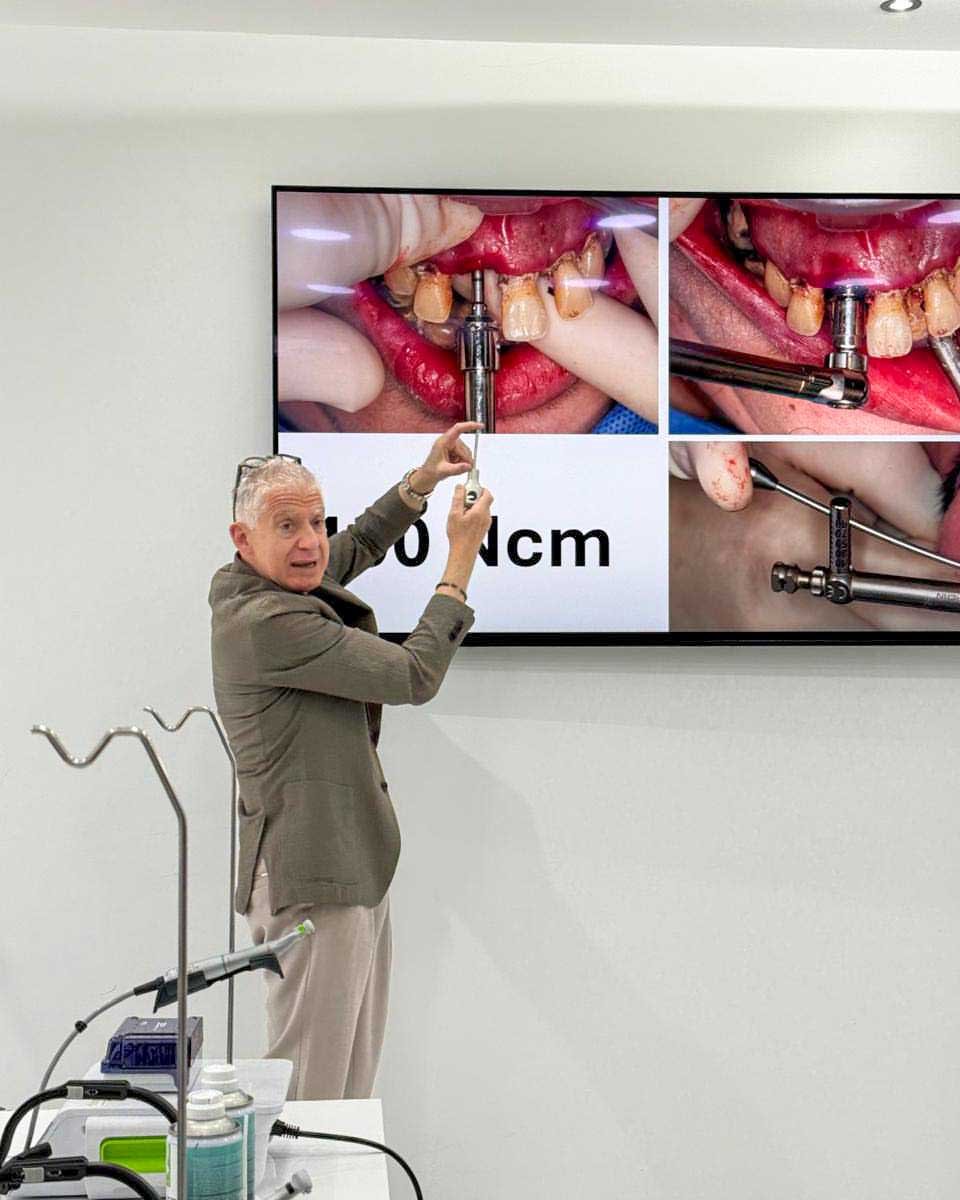
Precise placement — the angle, depth, bone quality, tissue health, and the surgical team's experience with complex cases — creates the biological conditions for long-term success. An implant placed with strong primary stability, in the right position, in healthy bone, gives you the best possible starting point.
This is where clinical accreditation matters. SameDay is an accredited ZAGA Center — part of the world's first and only international network of certified experts in zygomatic and advanced implant rehabilitation. ZAGA Centers undergo rigorous screening before acceptance, and each center is the exclusive certified reference for its region. There is only one per area.
SameDay is also an Associated Brånemark Osseointegration Center (ABOC) — a network built on the original research institution behind osseointegration itself, founded in Gothenburg, Sweden in 1989. Membership means operating in direct alignment with the biological principles and clinical protocols that have underpinned implant science for over 60 years.
These aren't honorary plaques. They represent a verified standard of surgical expertise, planning, and long-term outcome focus — exactly the foundation that implant longevity depends on.
Once you've chosen the right surgical team, your role begins after treatment.
Oral Hygiene at Home: The Non-Negotiable
Implants can't get cavities. But the gum and bone around them absolutely can be affected by bacteria.
There's a condition called peri-implantitis — in plain terms, it's the implant version of gum disease. Bacteria build up around the implant, the gum becomes inflamed, and if it's left unchecked, bone loss follows. That bone loss is what ultimately threatens implant stability.
Poor oral hygiene is the number one risk factor for peri-implantitis.3 The good news: it's largely preventable with consistent home care.
What good implant hygiene looks like:
The principle is exactly the same as caring for natural teeth. The difference is that implants require no less attention — and arguably, they reward consistency even more.
Professional Check-Ups: What Only a Dentist Can Catch
Even with excellent home care, there are things that only show up on an X-ray or in a dentist's hands.
At routine check-up and cleaning appointments, your dentist will:
A 25-year study found that patients in consistent professional maintenance programmes had significantly better implant and prosthesis survival rates over the full period — and the majority showed no signs of implant disease throughout.4
The key phrase there is no symptoms. Many early implant issues produce no pain, no visible swelling, no alarm signal. Your dentist can detect them before they become problems that are harder — or more expensive — to manage.
Watch Out for These Risk Factors
Some habits and health conditions are directly linked to poorer implant outcomes. Being aware of them is the first step to managing them.
- Smoking is one of the strongest predictors of implant failure. It impairs blood flow to the gums, slows healing, and increases the risk of both early failure and long-term complications. If you smoke, your dentist needs to know — and quitting significantly improves your long-term odds.5
- Bruxism — grinding or clenching your teeth, often during sleep — places abnormal mechanical stress on implants and the restorations on top of them. Many people don't know they grind until a dentist identifies it. If you're a grinder, a custom nightguard can protect your implants and your investment.
- Uncontrolled diabetes affects healing and immune response in ways that can compromise osseointegration. Well-managed blood sugar is associated with significantly better implant outcomes.6
- Certain medications, including some used for osteoporosis, may affect bone metabolism and implant integration. Always disclose your full medication list to your implant team before treatment.
Don't Ignore Small Changes
Once your implants are settled, they should feel stable and normal.
If you notice any of the following, book an appointment sooner rather than later:
None of these necessarily indicate failure — but they all warrant prompt assessment. Caught early, most issues are straightforward to manage.
What About the Crown or Bridge?
The implant post itself can last decades with good care. The restoration on top — the crown or bridge — is doing mechanical work every day, and it ages accordingly.
For a single implant crown, most patients can expect 15 to 20 years or more before replacement is needed. For a full-arch bridge, the timeline is similar, depending on material and loading. When the time comes, replacing a crown doesn't mean starting over. The implant post stays — a new restoration is fitted to the same foundation, with no new surgery required.
Your dentist will keep track of this at each check-up and give you well-timed guidance before anything needs attention.
The Straightforward Summary
Making your implants last isn't complicated — but it does require consistency. Brush and floss daily. Attend regular check-ups. Manage any health conditions that affect healing. Be honest with your dentist about habits like grinding or smoking.
The patients who do these things well can — and regularly do — go decades with their implants performing exactly as intended.
At SameDay, your long-term outcome matters to us as much as the day of surgery. As an accredited ZAGA Center and Associated Brånemark Osseointegration Center, our team will monitor your implants at every follow-up and give you the guidance you need to protect your results for as long as possible.
Ready to take the next step? Call or WhatsApp us at +971 4 315 8300 to book your no-obligation implant consultation.
References
- Barkarmo, Sargon, and Jan Kowar. "Outcome of Single Dental Implants Over 38–40 Years: A Long-Term Follow-Up Study." Clinical Implant Dentistry and Related Research, vol. 27, no. 1, 2025, e13443. doi:10.1111/cid.13443. pubmed.ncbi.nlm.nih.gov
- Associated Brånemark Osseointegration Centers. "Osseointegration." ABOC, 2024. branemark.se
- Ting, Miriam, and Jon B. Suzuki. "Peri-Implantitis." Dentistry Journal, vol. 12, no. 8, 2024, p. 251. doi:10.3390/dj12080251. pmc.ncbi.nlm.nih.gov
- Frisch, Eberhard, Vanessa Wild, Petra Ratka-Krüger, Kirstin Vach, and Sabine Sennhenn-Kirchner. "Long-term Results of Implants and Implant-Supported Prostheses Under Systematic Supportive Implant Therapy: A Retrospective 25-Year Study." Clinical Implant Dentistry and Related Research, vol. 22, no. 6, 2020, pp. 689–696. doi:10.1111/cid.12944. pubmed.ncbi.nlm.nih.gov
- Sgolastra, Fabrizio, Ambra Petrucci, Marco Severino, Roberto Gatto, and Annalisa Monaco. "Smoking and the Risk of Peri-Implantitis: A Systematic Review and Meta-Analysis." Clinical Oral Implants Research, vol. 26, no. 4, 2015, pp. e62–e67. doi:10.1111/clr.12333. pubmed.ncbi.nlm.nih.gov
- Chrcanovic, Bruno R., Tomas Albrektsson, and Ann Wennerberg. "Diabetes and Oral Implant Failure: A Systematic Review." Journal of Dental Research, vol. 93, no. 9, 2014, pp. 859–867. doi:10.1177/0022034514538820. pubmed.ncbi.nlm.nih.gov