Dental implants have some of the highest success rates in dentistry. But if something feels wrong with yours, that's worth taking seriously — implant failure does happen, and catching it early is the difference between a simple fix and losing the implant altogether.
Here's what to watch for, why it happens, and what treatment — including retreatment of implants placed elsewhere — actually involves.
Signs Your Dental Implant May Be Failing
Pay attention if you notice any of the following around an existing implant:
- Pain or tenderness that doesn't settle, or that returns after the implant had healed and felt normal
- Looseness or movement — an implant should feel as stable as a natural tooth
- Bleeding gums, especially when brushing or flossing near the implant
- Swelling, redness, or pus around the implant site
- Gum recession that exposes part of the implant
- Discomfort when chewing or a bite that suddenly feels different
A healthy implant depends on the implant properly fusing to the jawbone — when this doesn't happen, the implant may need to be removed. Symptoms of this kind of failure typically include mobility, pain, and bleeding. In the earliest stage, inflammation is limited to the soft tissue around the implant with no bone loss yet — this stage is usually reversible if it's caught early. This is exactly why symptoms should never be brushed off as "probably nothing."
Possible Reasons an Implant Fails
- Peri-implantitis. This is the most common cause of long-term implant failure — a chronic infection of the gum, and eventually the bone, around the implant. Once it progresses, there's measurable deterioration in the bone supporting the implant, and it usually needs surgical treatment. Risk factors include a history of gum disease, poor plaque control, smoking, and diabetes.
- Poor osseointegration. Sometimes the implant simply doesn't fuse properly with the bone. Low bone density, uncontrolled diabetes, and smoking are common contributing factors. This tends to show up early, often within the first few months.
- Prosthetic complications. A broken screw or a loose abutment can also cause long-term failure — this isn't a problem with the implant itself, but with the crown or connecting hardware on top of it.
- Excess bite force. Grinding, clenching, or an uneven bite can put more pressure on an implant than it's designed to handle over time.
- How it was originally placed. An implant that looked fine at placement can still run into trouble years later, regardless of where it was originally done. If yours was placed at another clinic — in Dubai or abroad — that’s absolutely fine. We’re happy to take a look and figure out what’s going on.
What SameDay Can Do — Including Retreatment
Treatment depends entirely on how early the problem is caught and what's causing it.
- If it's caught early: deep cleaning, laser therapy, or a bite adjustment can often resolve the issue without surgery. Mucositis at this stage is generally treatable.
- If bone loss has already occurred: treatment often involves repairing the site with a bone graft, allowing the bone to heal, and then placing a new implant.
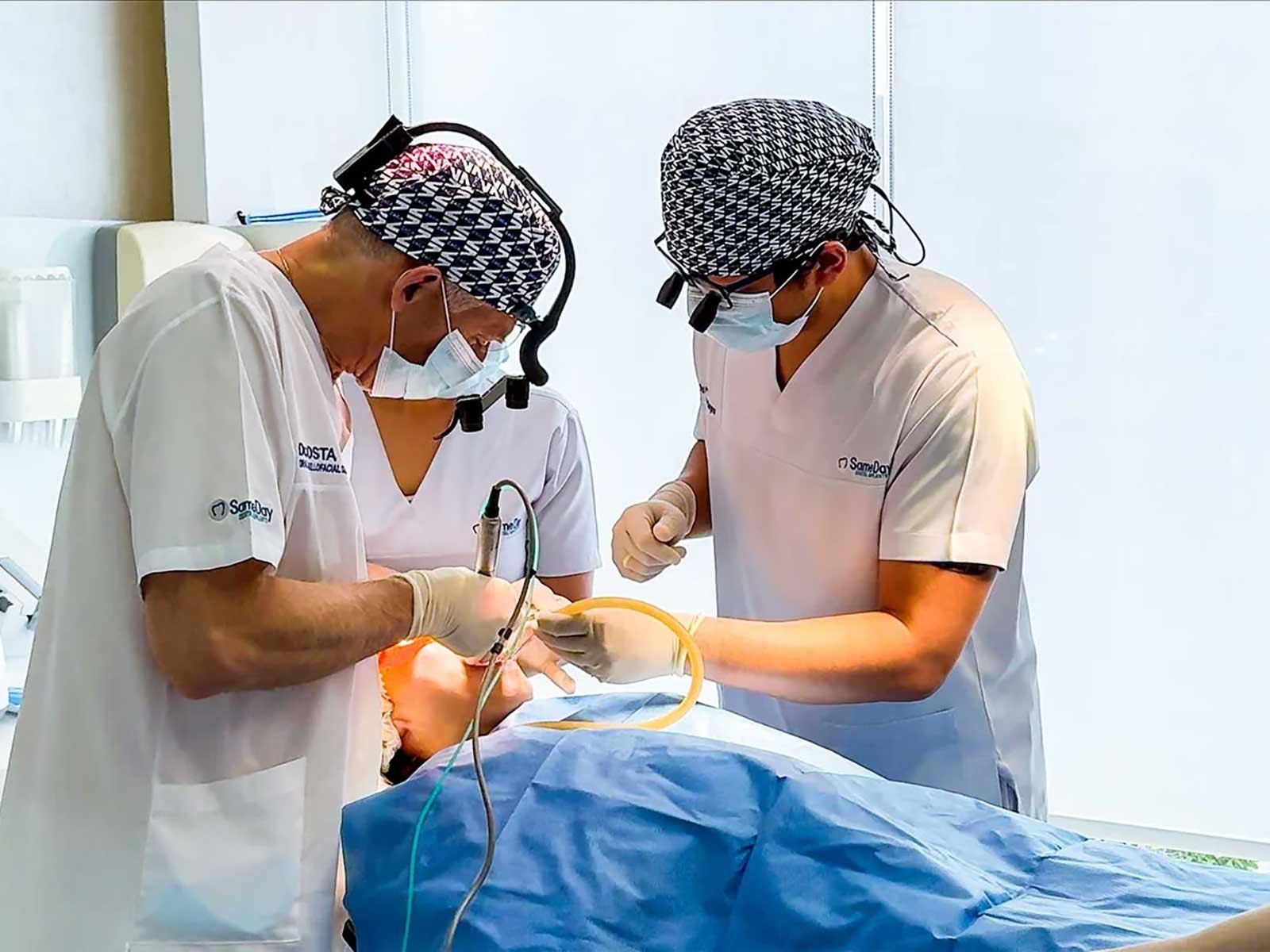
- If the implant has failed or needs replacing: our team can remove and replace it — whether it was originally placed at SameDay or elsewhere. We regularly retreat and restore implants that were placed at other clinics, assessing the cause of failure first so the same problem doesn't happen twice.
- For patients who've lost significant bone along with a failed implant, standard grafting isn't always enough. SameDay is the first and only ZAGA-certified center in the UAE and GCC, and can place zygomatic or pterygoid implants that anchor into denser bone elsewhere in the jaw — an option worth discussing if grafting alone isn't realistic for your case.
Every case is evaluated individually with 3D imaging before we recommend a path forward.
A failing implant is a treatable dental problem, not the end of your smile — but the earlier it's evaluated, the more options stay on the table. If something feels off around an existing implant, don't wait for it to get worse. Schedule an evaluation with Dr. Costa Nicolopoulos or Dr. Indraniil Roy, Specialist Oral & Maxillofacial Surgeons at SameDay Dental Clinic, to find out what's going on and what your options are.
If you've been looking into getting an implant for the first time, come visit us for a complimentary consult with free X-rays.
Our Dental Implant Specialists
Dr. Costa Nicolopoulos
BDS cum laude, FFD (SA) MFOS
Specialist Oral & Maxillofacial Surgeon
Specialist Oral & Maxillofacial Surgeon
Dr. Petros Yuvanoglu
DMD summa cum laude
Cert. Prosthodontics (Tufts, USA)
Adjunct Faculty, Tufts University School of Dental Medicine
Cert. Prosthodontics (Tufts, USA)
Adjunct Faculty, Tufts University School of Dental Medicine
Dr. Ramy Tamzouk
DDS, MSD
Specialist Prosthodontist
Specialist Prosthodontist
Dr. Indraniil Roy
BDS, MDS, MSc (Germany)
Specialist Oral & Maxillofacial Surgeon
Specialist Oral & Maxillofacial Surgeon